7 Presbyopia Lens Buying Tips for Global Buyers
Buying a Presbyopia Lens for international markets involves more than comparing unit prices. Buyers must weigh optical performance, wearer comfort, product consistency, and supplier communication. A lens that looks suitable on a specification sheet may still disappoint if its design does not match the intended users or frame range.
Small details matter. Check the available powers, lens materials, coatings, and fitting requirements. Ask how prescriptions and product specifications are verified, and request samples before committing to a large order. Review packaging, labeling, and documentation for the destinations you serve; requirements can differ between markets. Clear answers are a good sign. Vague promises are not.
Price still matters, of course. Yet the cheapest quotation may leave important questions unanswered, such as how defects are handled or whether repeat orders will match the approved sample. It is easy to overvalue a glossy catalog. I would look for evidence instead: clear technical data, responsive support, and a practical quality-control process. Even then, no supplier can remove every risk. That deserves a pause.
The tips ahead will help global buyers compare options with care, ask more useful questions, and avoid decisions based on price alone. Consider your customers’ needs, your sales channel, and the level of after-sales support you can provide. A thoughtful shortlist beats a rushed order. Still, real-world feedback may reveal a detail the checklist missed.

Understanding Presbyopia and How Corrective Lenses Work
Presbyopia is a gradual loss of the eye’s ability to focus on nearby objects. As the natural lens becomes less flexible with age, small print may blur, especially in dim light. You may notice yourself holding a phone farther away. That familiar gesture matters.
The World Health Organization’s World Report on Vision (2019) estimated that 1.8 billion people had presbyopia in 2015; 826 million had near-vision impairment because their condition was inadequately corrected. These figures show why lens selection deserves care, not guesswork. Single-vision reading lenses support near tasks, while bifocal and progressive lenses provide different viewing zones. Each design has trade-offs: a wider reading area may help with books, while gradual lens zones can take time to adapt to. Presbyopia does not explain every case of blurred near vision. A qualified eye-care professional can check the prescription, working distance, and eye health before lenses are ordered. For global buyers, fitting details matter. A desk reader working at 40 centimeters may need a different near prescription than someone using a tablet farther away. I would not assume one lens design suits everyone. Comfort can take adjustment.
Identifying Vision Needs and Choosing a Lens Type
Presbyopia often makes small print harder to focus on, especially in dim light. Before choosing lenses, note when blur appears: while reading a phone, checking a dashboard, or switching between a screen and a customer across a counter. These details help clarify whether you mainly need near, intermediate, or multiple viewing distances supported. An eye-care professional can assess your prescription and check for other causes of blurred vision. Don’t choose lens power from age alone.
Tips: Write down your usual reading distance and screen time. Try holding a book at your natural distance, not with your arms stretched. Readers suit close work; bifocals provide distinct near and distance zones; progressive lenses offer a gradual transition. For long hours at a desk, occupational lenses may prioritize screen and near ranges, but they may not suit driving. Fit matters, too: lens height and frame position can affect comfort. Small differences count.
Think about where you will wear the glasses most, then compare lens options with that routine in mind. Ask how the lenses handle your main tasks, what adaptation may feel like, and whether adjustments are available. A broader viewing range can be useful, yet it may take practice. I’d be cautious about assuming one pair will feel ideal everywhere; that expectation is easy to get wrong. Keep your prescription details and fitting measurements when ordering across borders, and confirm that the seller can provide them clearly.
Comparing Lens Materials, Designs, and Coatings
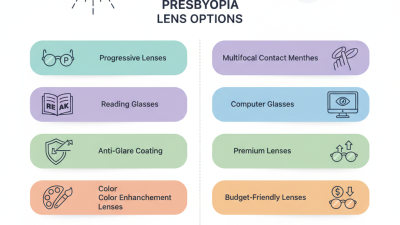
When comparing presbyopia lenses, match the design to how people actually use their eyes. Reading lenses suit near work, while bifocals provide distinct near and distance zones. Progressive lenses offer a gradual change between distances, but users may need time to adapt. For office settings, occupational designs can make screens and desk work easier to view. Ask suppliers for fitting guidance and clear measurements; a good design still depends on accurate fitting.
Material affects weight, thickness, impact resistance, and visual quality. Higher-index materials can make stronger prescriptions look thinner, though they may cost more. Polycarbonate is lightweight and impact-resistant, but its optical performance may not suit every wearer. Compare sample lenses under real lighting. Check edge thickness, clarity, and how the lens feels after several hours. Small differences matter.
Coatings deserve the same scrutiny. An anti-reflective coating can reduce distracting reflections, especially around screens and night lighting. A hard coat helps resist everyday scratches, but no coating makes a lens scratch-proof. UV protection should be specified and verified, not assumed from appearance. Request written details on coating tests, cleaning instructions, warranty terms, and batch consistency. Still, coatings cannot correct poor lens selection or fit. I’d avoid judging samples under showroom lights alone; daylight can reveal issues that bright indoor displays hide.
7 Presbyopia Lens Buying Tips for Global Buyers: Comparing Lens Materials, Designs, and Coatings
Typical refractive indices of common ophthalmic lens materials. Higher-index materials can make a lens thinner for the same prescription, but thickness also depends on prescription strength, lens design, and frame size.
Buying context: Presbyopia designs include single-vision reading lenses, bifocals, and progressives; choose based on the wearer’s near, intermediate, and distance needs. Anti-reflective coatings reduce surface reflections, while hard coatings help resist scratching. Confirm UV protection and coating specifications with the supplier, as features vary by product. Index values are typical and may vary by formulation.
Checking Prescriptions, Quality Standards, and Product Options
For global buyers, begin with a current prescription from a qualified eye-care professional. Check the reading addition, distance correction, and pupillary distance; do not assume an old pair still fits. Ask the supplier to confirm how each value should appear on its order form. Small details matter. A misplaced decimal or unclear prescription can lead to lenses that feel uncomfortable during close work.
Compare product options with the wearer’s routine in mind. Single-vision reading lenses may suit someone who mainly reads at a desk. Progressive lenses offer multiple viewing zones, but their fit and adaptation can be more demanding. Ask about lens material, coatings, frame compatibility, and available magnification ranges. A wider selection is not always better. It is easy to focus on price and overlook whether the lens design matches daily tasks.
Review quality documents before placing a bulk order. Request specifications, inspection records, and applicable conformity documents, then check that they match the exact lens type being supplied. Standards and labeling requirements vary by destination, so verify current local requirements rather than relying on a generic certificate. Samples can reveal practical issues, such as glare under office lights or markings that are hard to read. No checklist catches everything; inspect a sample under ordinary working conditions before approving the full shipment.
Evaluating Suppliers, Pricing, and After-Sales Support
For global buyers, evaluating presbyopia lens suppliers means looking beyond the unit price. Fricke and colleagues’ 2018 study in Ophthalmology estimated that 1.8 billion people had presbyopia, with 826 million experiencing near-vision impairment linked to uncorrected presbyopia. That scale makes consistent optical quality and dependable supply important. Ask for lens design specifications, inspection records, sample units, and clear production lead times. Compare the full landed cost, including packaging, freight, replacement terms, and expected defect rates. The cheapest quote can become costly.
Tips: Check how suppliers verify optical power and surface quality. Request traceable batch records. Test samples under realistic lighting and working distances. Compare prices on identical specifications. Confirm minimum order quantities and delivery windows. Ask who handles claims, and how quickly. Get warranty limits and replacement procedures in writing.
After-sales support should be specific, not just a promise of “assistance.” Ask for a named contact, response-time target, and a process for investigating scratched, chipped, or incorrectly supplied lenses. Clarify whether evidence, such as photographs or batch numbers, is required for a claim. A supplier may answer quickly before an order, then slowly afterward; that possibility deserves a direct question. Keep evaluation notes and sample results, even when the process feels repetitive. A small trial order can reveal more than a polished presentation.