
Polycarbonate vs High-Index Lenses: What's the Difference?
When choosing the right optical lenses, polycarbonate lenses and high-index lenses are two of the most commonly compared options.
In this guide, we'll break down the key differences between polycarbonate and high-index lenses in terms of:
material, thickness, weight, impact resistance, optical performance, and ideal use cases.
Polycarbonate lenses are made from a thermoplastic material originally developed for aerospace applications. Today, Polycarbonate lenses are widely used in eyewear due to their high impact resistance and lightweight properties.
- Refractive index: 1.59
- Extremely impact-resistant (up to 10x stronger than standard plastic lenses)
- Lightweight and comfortable
- Ideal for safety glasses, sports eyewear, and children's glasses
Because of their durability, polycarbonate lenses are often required for industrial safety standards and protective eyewear.
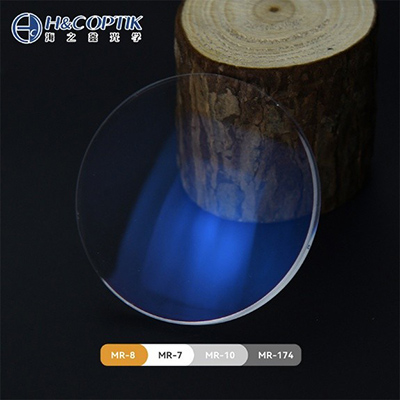
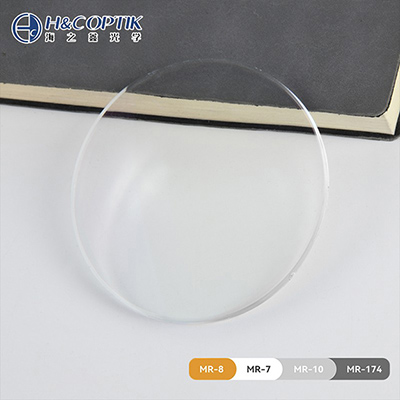
High-index lenses are designed for people with High prescriptions. They use advanced optical materials that bend light more efficiently. This allows lenses to be thinner and flatter than standard plastic or polycarbonate lenses.
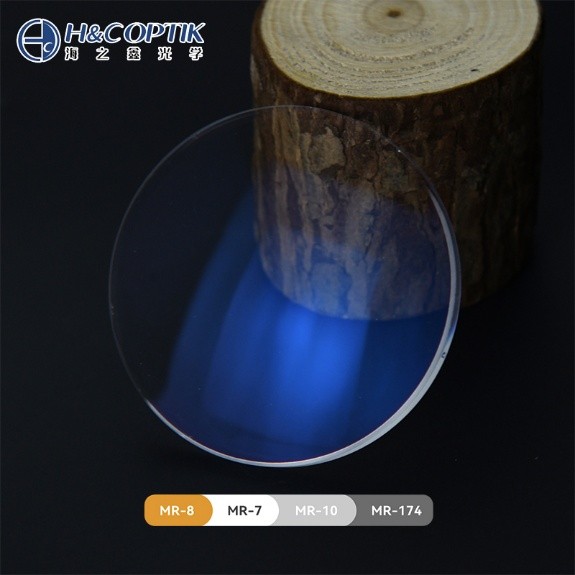
At H&C Optik, our high-index lenses are produced using MR™ series materials: MR-7 and MR-8
- Refractive index: 1.67
- Ultra-thin lens design for strong prescriptions
- Strong durability
- Good optical clarity with stable Abbe value
- Suitable for mid to high prescriptions
- Refractive index: 1.60
- Ultra-thin lens design for strong prescriptions
- Reduced edge thickness for improved aesthetics
- Ideal for high-end markets
- Commonly used in rimless designs
The higher the index, the thinner the lens—making high-index lenses popular in premium optical markets.
| Feature | Polycarbonate Lenses | High-Index Lenses |
|---|---|---|
| Refractive Index | 1.59 | 1.67 (MR-7) / 1.60 (MR-8) |
| Thickness | Medium | Thinner (especially for strong prescriptions) |
| Impact Resistance | ⭐ ⭐ ⭐ ⭐ ⭐ | ⭐ ⭐ ⭐ |
| Optical Clarity | Good | Very good |
| Abbe Value | -30 | 32–42 (varies by index) |
| Weight | Very light | Light |
| Best For | Safety, kids, sports | High prescriptions, fashion eyewear |
| Cost | Lower | Higher |
- Impact resistance is the top priority
- The lenses are for children or sports users
- You need safety eyewear
- Cost control is important
- The prescription is strong (−4.00 or higher)
- Cosmetic appearance matters
- Thinner, more refined lenses are preferred
- The eyewear is positioned as fashion-focused
For lens wholesalers and optical distributors, offering both polycarbonate and high-index lenses is the best strategy:
- Polycarbonate lenses are ideal for 1) volume orders, 2) safety programs, 3) emerging markets
- High-index lenses cater to 1) optical chains, 2) private labels, 3) premium customers
At H&C Optik, we manufacture and supply polycarbonate lenses and high-index lenses (1.61 / 1.67 / 1.74) with consistent quality!
At H&C Optik, our high-index lenses are produced using MR™ series materials, including MR-7 and MR-8, They are widely recognized for their stable optical performance.