Leave Your Message

Top Blue Filter Lens Manufacturers for Global Buyers?

Choosing the right Blue Filter Lens manufacturer can shape product quality, user comfort, and long-term supply stability. Global buyers often compare more than price. They examine optical performance, coating durability, material consistency, and production capacity. A lens may look clear under showroom lighting, yet show color distortion during screen-based testing. Small differences matter.

Reliable manufacturers usually provide measurable specifications. These may include blue-light filtering ranges, light transmission data, refractive index, surface hardness, and coating test results. Experienced suppliers can also explain how their lenses perform in prescription eyewear, protective glasses, or digital-use products. Factory audits add practical evidence. Buyers should review sample batches, inspect edge finishing, and check whether packaging protects lenses from scratches during shipping. Real production experience matters here.

Certifications and traceable quality records strengthen supplier credibility. However, certificates alone should not decide the purchase. A document may be valid but poorly matched to the buyer’s market or product design. That assumption can fail. Communication also deserves attention. Can the manufacturer answer technical questions clearly? Can it maintain color consistency across repeated orders? Can it respond when a sample needs adjustment? No shortlist is flawless. Even established suppliers may have delays, minimum-order limits, or unclear testing methods. This guide examines leading Blue Filter Lens manufacturers through product quality, technical expertise, manufacturing reliability, customization support, and buyer feedback. The goal is practical comparison, not a perfect ranking. A careful buyer should verify current capabilities before signing any agreement.
Top Blue Filter Lens Manufacturers for Global Buyers?

What Are Blue Filter Lenses and How Do They Work?

Blue filter lenses are optical lenses designed to reduce selected wavelengths of blue-violet light. They do not block all blue light.

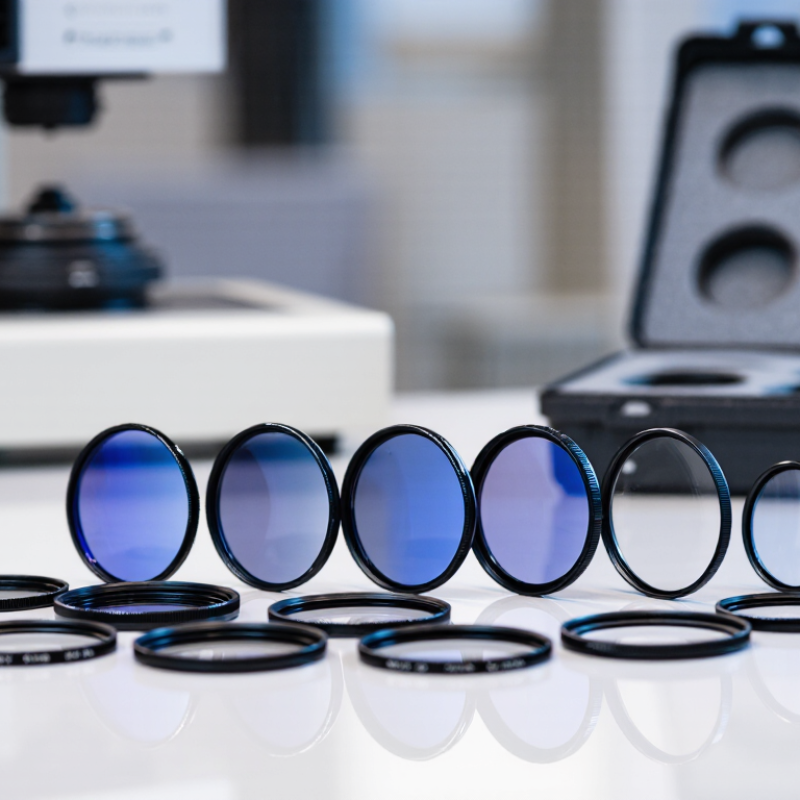
Most products target part of the 400–500 nanometer range through a coating, tinted material, or both. Some lenses reflect light from the surface, while others absorb it inside the lens.

The visible result may appear almost clear, slightly amber, or noticeably yellow. A stronger tint can reduce screen glare, but it can also change color perception. That trade-off matters.

Real performance should be checked with a spectrophotometer, not judged by appearance alone. Global buyers should request transmission curves, lens material details, coating durability results, and quality-control records.

A reliable manufacturer should explain the tested wavelength range and the intended use, such as office screens, night driving, or laboratory work. One filter cannot serve every situation.

It is also worth questioning broad health claims. Current evidence does not prove that blue-filter lenses prevent eye disease, and sleep benefits may depend more on evening brightness and exposure time.

The category is not perfectly defined. In practice, comfort, glare control, accurate color, and frame fit often matter more than the darkest lens. A good product can still be improved. Testing under real lighting remains essential.

Which Standards Define Quality in Blue Filter Lens Manufacturing?

Quality in blue filter lens manufacturing begins with measurable optical performance, not marketing language. ISO 8980-3 defines transmittance requirements for spectacle lenses, while ISO 8980-1 addresses refractive power and optical precision. These standards help buyers check whether a lens delivers its stated prescription across the usable surface. ISO 8980-5 also supports testing for abrasion resistance. A lens that filters blue wavelengths but scratches after weeks is not a quality product.

There is no single global standard that proves a lens improves sleep, eye comfort, or digital fatigue. This matters. The 2023 Cochrane review examined 17 randomized studies involving 619 adults and found limited short-term benefits from blue-light filtering lenses. Buyers should request spectrophotometer reports, wavelength curves, color distortion data, and batch traceability. ANSI Z80.1 can also guide prescription-lens verification in applicable markets. Ask how samples were tested, under which laboratory conditions, and whether results cover the finished lens or only the coating. Small details expose weak claims. Some suppliers may provide impressive filtering percentages without stating the tested wavelength range. That is a real gap, and buyers should challenge it. Surface quality, coating adhesion, impact performance, and accurate prescription power still deserve equal attention.

Top Blue Filter Lens Manufacturers for Global Buyers? - Which Standards Define Quality in Blue Filter Lens Manufacturing?

A standards-based comparison framework for evaluating blue-filter lens quality, production capability, and export readiness.

Quality Dimension Relevant Standard or Reference What the Standard Covers Practical Buyer Verification Why It Matters for Blue-Filter Lenses
Optical power and prescription accuracy ISO 8980-1; ANSI Z80.1 Requirements and tolerances for finished spectacle lenses, including optical power and related measurements. Request batch-level power measurements, cylinder-axis records, and a documented tolerance procedure. Blue filtering must not compromise prescription accuracy or visual comfort.
Spectral transmittance ISO 8980-3; ISO 8980-5 Transmittance properties and abrasion-resistant treatment evaluation for ophthalmic lenses. Ask for spectrophotometer curves, measurement geometry, test wavelength range, and pre-/post-treatment results. “Blue filter” is not a single universal specification; the actual transmission curve is the most important evidence.
Ultraviolet protection ISO 8980-3; applicable regional product requirements Spectral transmittance characteristics, including assessment of ultraviolet transmission where applicable. Verify the stated UV cut-off and request independent or calibrated laboratory test results. A lens can reduce selected blue wavelengths while still requiring separate verification of UV performance.
Haze and optical clarity ISO 8980-3; applicable national optical quality requirements Optical performance and visual quality characteristics of spectacle lenses. Request haze measurements, visual inspection criteria, and defect limits for inclusions, waves, bubbles, and coating marks. Excessive haze can reduce contrast and create glare, even when the blue-filter spectrum is within target limits.
Surface durability and abrasion resistance ISO 8980-5 Requirements and test methods related to abrasion-resistant treatments on ophthalmic lenses. Confirm the test method, sample conditioning, pass/fail criteria, and coating adhesion records. Blue-filter coatings and multilayer stacks must remain stable during cleaning and daily handling.
Impact resistance and mechanical safety ISO 14889; ANSI Z87.1 where occupational protection is claimed Basic safety requirements for uncut finished spectacle lenses; ANSI Z87.1 addresses occupational and educational eye protection. Check whether the product is standard ophthalmic eyewear or protective eyewear, and request the matching impact-test report. A blue-light claim does not automatically mean the lens is rated for industrial or high-impact use.
Frame-mounted lens performance ISO 21987 Requirements related to mounted spectacle lenses and the relationship between lens specifications and the completed eyewear. Review edging accuracy, mounting inspection, axis retention, lens seating, and finished-product quality records. A high-quality blank can still produce an inaccurate or uncomfortable finished pair if mounting control is weak.
Photobiological safety claims IEC 62471 where a photobiological-risk assessment is relevant Photobiological safety evaluation of lamps and lamp systems; it is not a general certification for every blue-filter spectacle lens. Ask the supplier to define the exact product claim and provide a test report that directly matches the claimed application. It helps prevent unsupported claims about protection from screens, LEDs, or specific blue-light hazards.
Manufacturing consistency ISO 9001 quality-management framework Documented processes for quality control, corrective action, traceability, and continual improvement. Verify certificate scope, production-site coverage, lot traceability, nonconformance records, and calibration controls. Consistent spectral performance across batches is essential for global buyers and private-label programs.
Global regulatory readiness Applicable destination-market rules, including EU PPE or medical-device requirements when relevant Market-specific classification, labeling, technical documentation, conformity assessment, and claims control. Confirm the intended product classification, required markings, declaration documents, language labels, and importer responsibilities. Compliance depends on the product’s intended use and destination; one certificate may not cover every market.
Buyer note: Blue-light filtering performance should be evaluated from the complete spectral-transmittance curve rather than from a marketing label alone. The required standards and conformity documents depend on lens type, intended use, and destination market.

How to Compare Leading Blue Filter Lens Manufacturers Worldwide?

Comparing leading blue filter lens manufacturers worldwide requires more than checking price lists. Buyers should examine optical performance, production control, and evidence behind every claim. Request the lens material, blue-light transmission range, visible light transmission, refractive index, and coating details. A reliable manufacturer should provide current test reports, not vague marketing language.

Test physical samples in realistic conditions. View a white screen, printed text, and an LED-lit workspace through each lens. Check color distortion, reflections, edge clarity, and coating uniformity. Small scratches often appear after repeated cleaning, so use a standard cleaning routine and inspect the surface under angled light. Ask how each batch is measured and whether production records remain traceable. Independent laboratory testing can strengthen confidence, especially when results match the manufacturer’s internal data.

Manufacturing capability also matters. Compare sample consistency, minimum order quantities, lead times, packaging protection, and replacement policies. Ask whether the factory can maintain the same tint across different prescriptions and frame sizes. Communication reveals practical expertise; technical answers should be specific and easy to verify. No comparison is perfect. A polished sample may not represent a full production run, and a low price can hide weaker quality control. Buyers should repeat tests with several batches before making a long-term decision. Availability of trained inspectors, calibration records, and documented corrective actions can separate a dependable supplier from an attractive but uncertain option.

What Production Technologies Affect Blue Filter Lens Performance?

For global buyers, blue filter lens performance begins with material selection and process control. Optical-grade resin and glass respond differently to heat, moisture, and coating stress. Resin lenses are lighter, but they may show more thermal distortion. Glass usually offers stronger dimensional stability. The right choice depends on the intended application.

Vacuum deposition creates controlled multilayer coatings on the lens surface. Each layer must maintain a precise thickness, often measured at nanometer scale. Small variations can shift the filtering range.

Experienced manufacturers use spectrophotometers to check transmission, reflection, and blocking performance across the visible spectrum. They also inspect haze, color consistency, and surface defects under controlled lighting.

Curing matters too. Poor curing can leave internal stress or reduce coating adhesion. Abrasion testing, humidity exposure, and temperature cycling reveal weaknesses before shipment. Independent laboratory checks can improve buyer confidence, especially for large international orders. Yet no process is perfect. A lens may pass optical testing and still feel slightly different in real use. That gap deserves attention. Buyers should request batch records, test conditions, and sample evaluations before approving mass production. Clear tolerances are more useful than impressive claims.

How Can Global Buyers Select the Right Manufacturing Partner?

Global buyers should select a manufacturing partner through evidence, not attractive blue-light claims. The Vision Council’s 2023 Digital Eye Strain report documents widespread discomfort linked to prolonged screen use. However, it does not prove that every blue-filter lens prevents eye disease.

That distinction matters.

Ask each supplier for spectral-transmission curves, coating test results, and batch traceability. A reliable factory should show independent measurements across the 400–500 nanometre range. Check whether the lens meets ISO 8980-1 requirements for optical properties and durability. Request samples from different production batches. One sample is not enough.

Review coating adhesion, abrasion resistance, colour distortion, and residual reflection under office lighting. Sleep-related claims also need care. A 2019 Cochrane review found uncertain evidence that blue-light filtering lenses improve sleep or reduce eye strain. Treat bold claims carefully.

Very carefully.

A capable partner should explain its test method in plain English. It should also disclose material tolerances, minimum order quantities, lead times, and corrective-action procedures. Ask how rejected lenses are isolated and recorded. During an audit, inspect clean-room controls, humidity monitoring, and packing conditions. These details reveal operational experience.

Price still matters. It should not lead the decision. I would score quality systems, transparent documentation, and communication before negotiating volume. My own selection process would include one uncomfortable step: challenge the supplier’s strongest marketing statement. If the technical team cannot answer clearly, reconsider the partnership.