Leave Your Message
Digital screens are now part of daily work, but their effects on vision deserve careful, evidence-based discussion. The World Health Organization’s 2019 World Report on Vision estimated that at least 2.2 billion people worldwide have near or distance vision impairment. That figure does not prove that screen exposure causes vision problems, or that a particular lens can prevent them. Important distinction.
For buyers comparing a China-based Blue Filter Lens manufacturer and supplier, product claims should be matched with clear test records. A 2023 Cochrane review assessed 17 randomized trials involving 619 adults. It found that blue-light-filtering spectacle lenses may not meaningfully reduce short-term computer-related eye strain; the certainty of evidence was limited. A lens is not a cure. Its performance depends on measurable details, including spectral transmission, coating consistency, optical power, and visible clarity. Request independent test reports, sample lenses, and batch-level quality records before placing a large order. Then compare the specifications under the same lighting conditions.
Reliable suppliers should explain what their lenses filter, what they do not, and how each production batch is checked. Look closely at a lens under office lighting: uneven reflections, color shifts, or coating marks are practical reasons to ask more questions. No single specification tells the whole story. A careful manufacturer welcomes scrutiny, shares verifiable data, and avoids promising medical benefits that its evidence cannot support.
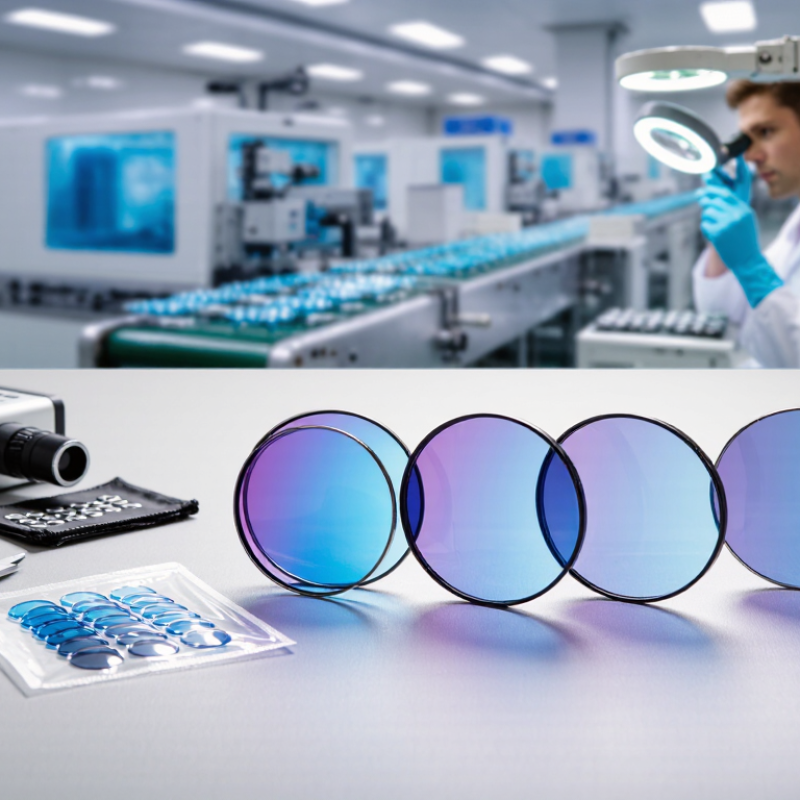
Blue filter lenses reduce some blue-violet light reaching the eyes. They do this through a filtering material, a surface coating, or both. The lens does not simply block every blue wavelength. Its transmission depends on the design and the wavelength being measured.
A useful check is a spectral transmission test. It shows how much light passes through at different wavelengths, rather than relying on a lens’s appearance alone. Two lenses can look equally clear but filter different amounts. Some coatings reflect selected wavelengths; others absorb more light within the lens material. A slight yellow tint may be visible, though not every blue-filter lens looks tinted. The details matter.
That sounds simple, but it isn’t. Blue light also comes from daylight, and blue-filter lenses do not replace good screen habits or regular breaks. Evidence about their ability to ease digital eye strain remains mixed. For a practical comparison, ask for measured transmission data and check whether colors appear natural for your work. A white page should still look reasonably white. That small detail is easy to overlook.
| Lens Category | Typical Target Wavelengths | How the Filter Works | Appearance and Optical Effect | Common Applications |
|---|---|---|---|---|
| Clear selective blue-filter lens | Often designed to reduce part of the approximately 400–455 nm blue-violet region; the exact range varies by lens. | A coating, lens material, or combination of both reflects or absorbs selected wavelengths while transmitting most visible light. | Usually appears clear or slightly tinted. A faint colored reflection may be visible on the lens surface. | Everyday eyewear and indoor use where a mostly clear appearance is preferred. |
| Blue-light-absorbing tinted lens | May target a broader portion of the blue range, commonly described as approximately 400–500 nm. | Absorbing colorants in the lens material reduce transmission within selected wavelength bands. | Typically has a noticeable yellow, amber, or orange tint; stronger tints can change color perception more. | Special-purpose eyewear and situations where stronger blue-light attenuation is desired. |
| UV-cut lens with partial blue filtering | UV protection commonly covers wavelengths below approximately 400 nm; blue-light filtering beyond that point depends on the lens design. | UV-absorbing materials or coatings block ultraviolet radiation. Any filtering of visible blue light is a separate design feature. | Can look clear. A UV-cut label alone does not indicate how much visible blue light is filtered. | General-purpose eyewear requiring ultraviolet protection, with optional additional visible-light filtering. |
| Blue-reflective coated lens | Reflection is specified by the coating design and may affect selected visible wavelengths. | Thin-film layers create wavelength-dependent reflection through optical interference; remaining light passes through the lens. | May show a blue or violet surface reflection. The reflection color alone does not establish the amount of filtering. | Eyewear where a reflective coating is part of the optical or cosmetic design. |
| Photochromic lens with optional blue filtering | Blue-light transmission depends on the lens material and any added filter; photochromic response is primarily a change in tint with light exposure. | Photochromic molecules change structure under activating light, darkening the lens. This is distinct from selective blue filtering. | Darkens in response to activating light and becomes clearer when that light is reduced; performance varies by product and conditions. | Indoor-to-outdoor eyewear when adaptive tinting is useful. |
| Wavelength and specification note | The visible spectrum is approximately 380–780 nm. “Blue light” has no single universal cutoff; blue-violet is often discussed around 400–455 nm. | Filtering performance is measured as spectral transmittance across wavelengths, rather than inferred from lens color or a product name. | Two lenses that look similar can have different transmission curves. Ask for a measured spectral-transmittance chart when comparing specifications. | Useful when evaluating lenses for a particular application or comparing technical data. |
| Important: Wavelength ranges and filtering levels vary among lens designs and are not universal standards. Blue-filter lenses do not necessarily block all blue light, and their filtering characteristics should not be treated as proof of a medical benefit. Choose lenses according to verified optical specifications and advice from an eye-care professional. | ||||